THE BOARD

THE PIECES

THE KING

THE QUEEN

THE ROOK

THE BISHOP

THE KNIGHT

THE PAWN

CHECK

CHECKMATE

DRAWS

NOTATION

OPENING

MIDDLEGAME

ENDGAME

CASTLING

INTERPOSE

PINNING

KNIGHT FORK

DOUBLE ATTACK

DISCOVERED ATTACK

DISCOVERED CHECK

DOUBLE CHECK

OVERWORKED PIECE

REMOVING THE GUARD

CLEARANCE

INTERFERENCE

SACRIFICES

ZUGSWANG

OPPOSITION

SKEWER

GENERAL RULES


The Pieces


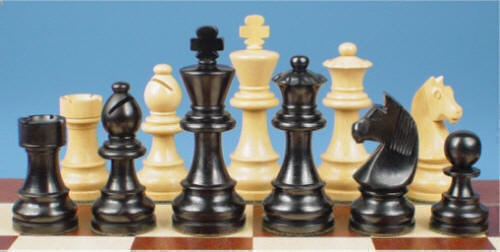
Typical Staunton wood pieces used in a game of Chess (Fig. 1). The word 'Staunton' refers to a particular style of Chess pieces. According to the rules of Chess, this type is to be used for competitions. Nathaniel Cook is credited with the design of the pieces and the name. Howard Staunton was an English Chess Master (1810-1874). One player has the light or white pieces and the other one has the dark or black pieces.


Staunton Wood Chess Pieces

Fig. 1


At the beginning of a game, each player has 16 pieces (Fig. 2). Kings, Queens, and Rooks are sometimes called major pieces. Bishops and Knights are called minor pieces. The rest of the pieces are called Pawns.


Players initiate the game with 16 pieces each

 White Pieces         

Black Pieces          

1
King
1
King
1
Queen
1
Queen
2
Rooks
2
Rooks
2
Bishops
2
Bishops
2
Knights
2
Knights
8
Pawns
8
Pawns

Fig. 2


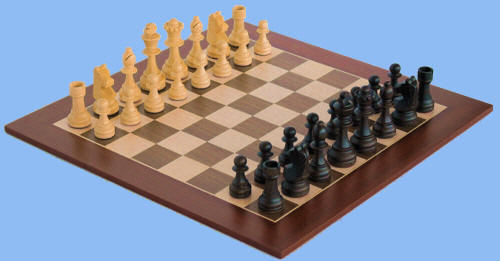
Typical pieces setup and Chessboard (Fig. 3). Make sure to have the correct position of the Chess pieces on the board at the beginning of a game.


Staunton Wood Chess Pieces and Chessboard

Fig. 3


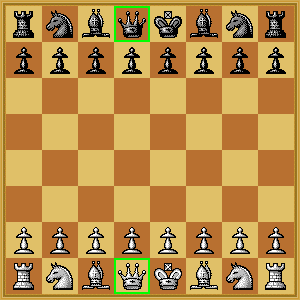
Note that the white Queen should always be placed in a light square of the board and black Queen in a dark square of the board (Fig. 4). 


Correct Queen position

Fig. 4


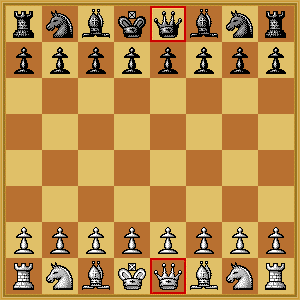
This next diagram shows an incorrect Queen position (Fig. 5).


Incorrect Queen position

Fig. 5


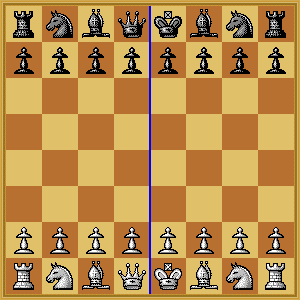
The left side of the board where both Queens are placed is called 'Queen side of the board' and the right side where both Kings are placed is called 'King side of the board' (Fig. 6).


Board Queen Side

Board King Side


Fig. 6


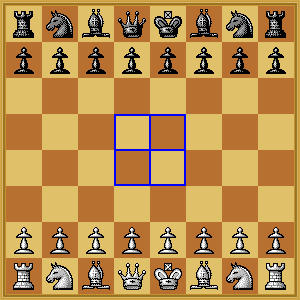
The most important squares on the Chessboard are the four center ones (Fig. 7). Major and minor pieces placed there can greatly increase their mobility, exert considerable pressure and tend to control more space.


Chess Board center squares

Fig. 7


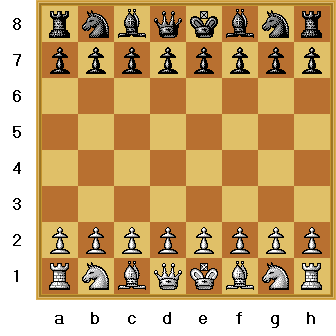
Coordinates give a unique numeration for all the squares on the Chessboard.  The first horizontal row of the white pieces is used for the denomination of all columns.  The squares of such columns are named from left to right with the letters: a, b, c, d, e, f, g and h.  The first vertical column is used for the denomination of all ranks.  The squares of such ranks are named from down to up with the numbers: 1, 2, 3, 4, 5, 6, 7, and 8 (Fig. 8).


Board with coordinates (White view)


Fig. 8


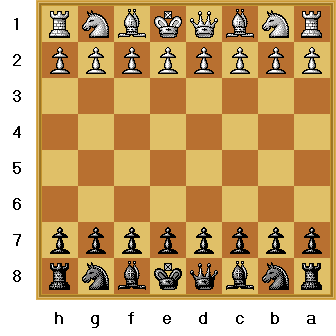
Black pieces should read coordinates letters and numbers in reverse order: h to a and 8 to 1 (Fig. 9).


Board with coordinates (Black view)


Fig. 9


More about the Chess pieces:

Only one (1) Chess piece is allowed to be placed within a square. The player assigned the white Chess pieces always moves first and afterwards, black moves. Both players can move any legal move they wish. Only one move per turn is permitted and no player is allowed to skip his next move.

2.1 Material:

Chess pieces should be made of wood, plastic or an imitation of these materials.

2.2 Height, weight, proportions:

The King's height should be 8.5 cm. to 10.5 cm. The diameter of the King's base should measure 40% to 50% of its height. The size of the other pieces should be proportionate to their height and form; other elements such as stability, aesthetic considerations etc., may also be taken into account. The weight of the pieces should be suitable for comfortable moving and stability.


  Back

Up

Next

 Home

Chess Gallery

Chess Poster

   e - mail

 Spanish