|

Letter #12 - 2002
Sub:
Lasker vs. Steinitz
Date:
3/19/02 10:49:34 AM PST
From: Erik de Vries (Spain)
To:
service@chess-poster.com
Hello Sirs,
Today, with an intention of studying openings, I logged into the
Spanish section of chess-poster.
In the Lasker-Steinitz game that stands as an overview of the “Italian game”, I found the following error: 11 exf6, since the f6 square is empty and there is no piece for the white Pawn to capture.
Yet, the site is well designed; it's clear that in the visual aspect, a lot effort has been made.
Keep it up.
Sincerely,
Erik de Vries
Dear viewer,
We reviewed the game you mentioned in your e-mail and we found no error because Steinitz applies the legal
“in passant” rule. If you are not very used to with such rule, we'll try to explain next.
The rule “in passant” some times called “en passant” worldwide, is a special maneuver that a player can exercise (or ignore and make another move) on his turn.
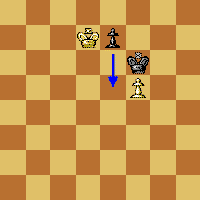
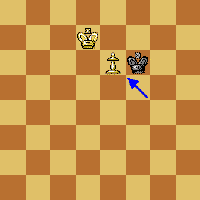
If you (white) have a Pawn on the fifth rank as in fig. 1 and your opponent (black) moves his Pawn two squares ahead, you can capture it on your next turn as if it would have moved one square only (fig.2).
|
Fig. 1 |
Fig. 2 |
 |
 |
This rule was agreed upon by past players who believed it was not fair that a player could "pass" with impunity an opponent's Pawn on his initial position (with the option of advancing 1 or 2 squares) by moving two squares ahead.
Visit our “The Pawn”
page where you'll find a complete information about the properties and movements of the Pawn.
Thank you for visiting us,
chess-poster.com |



